History of Talent Marketplace: Definition, Differs from Job Boards, Benefits and Features

History of Talent Marketplace: Definition, Differs from Job Boards, Benefits and Features

History Of Talent Marketplace

In today’s world, some employers complain of not being promoted despite their relentless service for the company’s progress. However, the answer lies in the fact that this employer needs more talented workers with different skill sets, which they haven’t seen in them.

This is what gives birth to the talent marketplace and why companies are searching for the best possible talented workers to handle critical projects or assignments.

Talents marketplace is a well-connected, and transparent talent management system that helps employees to pursue their careers. It matches them with the right opportunity and potential roles based on their abilities, skills, career goals, and preferences. It also enables them to learn new skills or improve on the ones they are learning.

A perfect talent marketplace looks at a person’s complete identity, including their abilities and competencies, but also goes beyond that to take into account things like interests, working preferences, and learning styles. Beyond what individuals can accomplish, the market expands knowledge to encompass what people want to do and how they choose to do it.


Features of the Talent Marketplace

1. Keeping a record of diverse talent

The talent marketplace makes use of AI (artificial intelligence) to collate information about workers’ skill sets and job experience. This information is obtained mainly from their social media profiles such as LinkedIn, Twitter, etc, and also from their employment record.

This data is used to match people with an opportunity or jobs that fit their qualifications. The data is stored in the database and updated from time to time upon acquisition of new skills.

2. Predictive analysis

Predictive analysis is often used in the talent marketplace to know when important jobs need to be replaced when there is a case of retirement or promotion. The database can also be used to identify potential industry leader which in turn promote the career development of employees

3. Setting and achieving goals

Other features of the talent marketplace are goal setting and achievement. It can be used to set and track employees’ progress toward the created plans or objectives.


Benefits of the Talent Marketplace

1. It enhances diversity, equity, & inclusion (DEI)

Talent marketplace helps to promote Diversity, equity, & inclusion by ensuring both males and females are given preference based on their skills.

2. It increases employee retention and engagement

Generally speaking, employees look into what the future of work is before deciding to stay or leave. The talent marketplace builds great trust in the worker’s mind thereby increasing retention and engagement.

3. Becoming Agile

Agility is required in the manufacturing industry to boost production. The talent marketplace provides employers with the ability to be agile when locating internal talent for current and future roles and projects.

In conclusion, the talent marketplace provides a pool of talented employees ready to elevate the industry with their skill sets.


Articles that you may like:

Why Coming Back To The Job Market Is Tougher For Women After The Pandemic

How To Use People Analytics to Retain and Recruit Talent?


Download your The Inclusive Recruitment Process Checklist

The Lack Of Women of Color In The Leadeshhip

The Lack Of Women of Color In The Leadeshhip

Economic and occupational disadvantages are synonymous with black women’s experience working in corporate America. Racism and sexism are the top causes of stifled leadership opportunities for women, especially underrepresented women of color.

No mentorship or support system:

In today’s professional world, having mentors, connections, and network is integral in stepping up the ladder. Research indicates that black women are more ambitious about climbing the corporate ladder to advance in their companies when compared to their white women counterparts. One study shows 75% of Black women view themselves as very ambitious towards their career, with 40% hoping to make it to a management position. However, those rungs to the top are broken for them, because they are less likely to find mentors who will help them reach their career goals and ambitions. Only 26% of Black women say they had equal access to sponsorship and 59% say they never had an informal interaction with a senior leader. Hence, for every 100 men promoted to manager just 58 Black women are promoted to the same role. At a disadvantage from the beginning, Black women see the representation gap continue to widen with only 1.6% becoming vice presidents and 1.4% becoming C-suite executives, while white men hold 57% and 68% respectively.

The reason is two-fold. The sociologist, Tsedale Melaku notes that white executives show visible discomfort and pose unfamiliarity with mentoring or interacting with Black women in the workplace. Moreover, the second reason is the intentional exclusion and disenfranchisement of black women. More often than not, white executives do not want to include their black counterparts in teams or mentor them for higher-level positions. Women of color comprise only 4% of C-level positions despite comprising nearly 18% of the US population. Out of this, only 1% are black women. These patterns result in occupational underrepresentation and wage disparity for women of color, especially black women. It is significant to accept that the issue isn’t restricted to black women only. Asian American women and Latinas are also stereotyped and suffer from racialized and gendered harassment and bias when looking for mentors. 

They bypass the requirements of traditional leaders:

An integral step in realizing diversity starts with retention.  Recognizing how companies hire, promote, and retain employees is based on a specific leadership archetype. The models of leadership and demographic distribution are based on a Western approach of straight, white men. The job description of the companies looking to hire new people contains words like; “dominant, self-confident, available round the clock, and aggressive candidates/” which are typical keywords used to describe typical white males. This not only leaves women of color at a double disadvantage but women (as a gender) are at loss here. When women, especially of color, embody these traits they are not considered likable and are not respected. Their competence, skills, and intelligence are still doubted. Because, in short, the companies are looking for white males to take over their leadership positions and anything other than that is mostly considered unacceptable.

If this wasn’t enough, the status quo in corporate America is unbelievable. Black women are often reprimanded or rated ‘unprofessional’, ‘unfit to take a higher management position’ because they prefer Afrocentric hair. Native American women have one of the largest pay gaps in the workforce. Latina women as compared to non-Hispanic white women are twice as likely to work twice as hard to prove their cultural background has no impact on their qualifications, experience, or work style. Companies are less likely to employ Middle Eastern women who wear a headscarf. Asian-American women when compared with their white counterparts are generally considered less suitable for leadership positions.

This paired with all the other reasons in this report becomes one of the leading hindrances in the path of women of color who want to secure leadership positions even if they are well-qualified for it. 

The concrete ceiling:

Everyone has heard about a glass ceiling, but very few know what a concrete ceiling is. While the glass ceiling metaphor cuts it for white women, it does not for women of color. The difference between the two terms is that the concrete ceiling is a true depiction of the reality of women of color. Black, indigenous, and other women of color face double discrimination in an organization not just because of their gender but because of culture, race, and religious practices as well. This concrete ceiling is impenetrable not just metaphorically but in reality, women of color cannot see what is possible for them.

White women, generally, know what’s hindering their progress and growth in the workplace like the glass ceiling, and gender discrimination. On the other hand, women of color have no idea what obstacles are stopping them. It is because of the ramifications of double jeopardy constituting lower pay, fewer powerful jobs, fewer mentors, fewer sponsors, fewer desired positions, and very few people supporting them. Similarly, leadership biases, stereotypes, white standards of professionalism, racism, discrimination, harassment, lack of support, and emotional & mental exhaustion are only some of the things that comprise this concrete ceiling barring the way for women of color to the top. 

The Emotional Tax!

Let’s accept that women of color are tired. High blood pressure seems to be a common occurrence among women of color including those who are leaders. This leads to early retirement and resignation from their workplaces. They are conditioned to do more with less and expect even lesser in return. They are competing for crumbs, knowing that no matter what they do, they are most likely never getting to the top. The emotional tax, also called the black tax for black women, is taking a toll on the physical and mental health of women of color. This becomes a major cause for the lack of BIPOC in the leadership. When they somehow manage to break the glass ceiling, they often face the glass cliff. Glass cliff is when omen and/or people of color are moved into leadership positions when times are tough or the organization is in crisis. They are asked to prove themselves and their worth by cleaning the mess that white executives have spilled. Being in a precarious position means there are potentially higher chances of failure. This is just another way women of color pay the emotional tax. 

Approximately 62% of  Black workers in STEM fields as compared to 44% of Asians, and 42% of Hispanics have experienced various forms of racial or ethnic discrimination at work, including earning in the same role, exclusion from meetings, not receiving training to perform their jobs and receiving less support from managers. This is taking an emotional toll and putting a strain especially if women of color manage to get the position at the top. Asian, Black, Latinx, and multiracial professionals pay an Emotional Tax at work when they feel they must be on guard to protect against racial and gender aggressions. This becomes one of the most important reasons why they can’t get managerial positions because they are always watching their back. 

Black women are the fastest-growing group of entrepreneurs among women, having grown by more than 600% between 1997 and 2017. They hold the most degrees and yet are unrepresented at the highest ranks of leadership, boardrooms, and academic positions. This is because the microaggressions, bias, and huge loopholes in the existing employment practices, procedures, and processes are causing a huge cause of low retention and inclusion in the organization. 


You might be interested in this topic: How To Use Data To Engage More Black Women Graduates In STEM?

Latina Equal Pay Day

Latina Equal Pay Day

October 21st marks another day where women in the United States have to recognize that we are not paid equally. More than 50 years after the passage of the Equal Pay Act of 1963, Latinas typically earn only 57 cents for every dollar earned by white, non-Hispanic men and must work nearly 23 months to earn what white men earn in 12 months. Just last year, Latinas only earning $0.55 for every dollar paid to White men with very little improvement despite the awareness that has been pushed. In 1989, Latinas were paid $0.52 for every dollar paid to White men – only three cents in three decades, counting for a penny a decade until this year. 

According to LeanIn and McKinsey & Company’s 2020 “Women in the Workplace” report, for every 100 men promoted to manager, just 71 Latinas are promoted at the same rate and still with less pay. As we have learned during this equal payday series, women of color are facing barriers centered around sexism and racism that prevent them from being promoted to senior-level management roles. 

The pay gap revealed itself even more during the height COVID-19 where 3 in 10 were working in a front-line job (medical, day-care, customer service…etc.). Even with pay incentives, Latina women could not catch up with their white counterparts. For example, Latina doctors were paid 68% of the average hourly wage of non-Hispanic white male doctors – which makes a difference of $20.46 per hour. Across service jobs, the pay gap was a little better – Latina women in the service industry were paid between 90% and 94% of what non-Hispanic white men were. 

Outside of the working Latinas, we have to account for those who have lost their jobs and have had to make ends meet in any way they can. Whether it is a daycare, rent, food, or any other expense, being paid equally has only set Latina women back when they experience job losses. Unemployment assistance and welfare do not make an exception to this. Equal pay helps fund health savings account, 401k’s, and savings account in general at the same rate as others. So when loss is experienced, why is it fair to not have LESS to fall back on? It’s not.

23 months is unacceptable – Latina’s work longer than the average woman of color trying to catch up to the pay gap. In order to close the gap, PositiveHire helps women of color in the STEM industry move up the ladder and get into c-level roles. Movements like this are what help women of color reach the top and make the difference that our white counterparts have failed to do since 1963.


An Article you might be interested in:

Impactful Tips For Retaining Diverse Women

Native American  Women’s Equal Pay Day

Native American Women’s Equal Pay Day

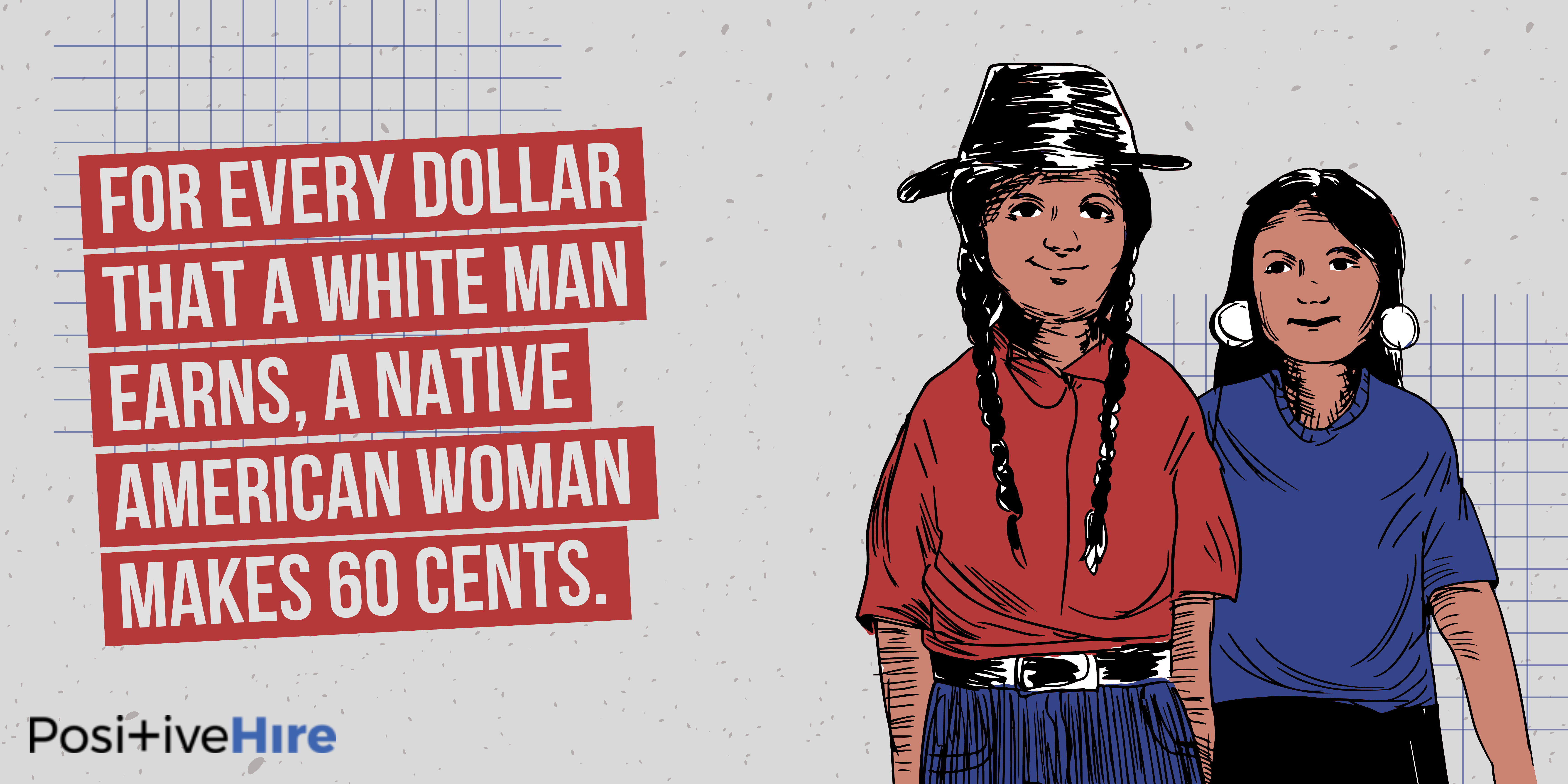
In the war of wages, Native American women continue to suffer losses. For every dollar that a white man earns, a Native American woman makes 60 cents. Over the course of their work life, an average Native American woman loses around $1 million dollars due to pay disparity.

To bring awareness to this issue, November 30t is celebrated as Native American Women’s Equal Pay Day.


The Significance of Native American Women’s Equal Pay Day


The significance of this date is important to note. It marks the day that Native American women need to work until they earn what their male, white, non-Hispanic counterparts earned the previous year.

In simpler words, it takes Native American women 23 months to earn what a white man earns in 12.

Sobering, isn’t it? Sure. but we’re only scratching the surface here. The pay gap Native American women face is not confined to white men only. It persists when compared with the earnings of white women, Black women, and even women of other tribal nations.

For example, while the gender pay gap between a white man and an Apache woman is 44%, it’s 22% for Aleut women and 55% for women of the Iroquois tribe.

If it sounds confusing, it is. The answers are not easy to come. Because, for one, we do not have sufficient data to form clear-cut diagnoses of this multifaceted issue. Native American women are a notoriously understudied group. No great efforts have been made to research the reasons that lie behind this undying gap.

But that, at least in part, may be due to the fact that Native American men and women only represent 1.7% of the U.S. population: 5.6 million people. For context, the U.S. population is 331.9 million. There are 41 million people in the Black population, the largest racial minority in the country. Hispanics and Latinos, the largest ethnic minority, are 62.1 million people strong.

And for another, the issues may be too complex to give us a bulleted list of simple challenges. Not only do Native American people need to be studied more, but everyone should be prepared and willing to address the uncomfortable truths that might come to the surface.

However, amid all this uncertainty, it is important to celebrate the victories, too.


The Victories of Native American Women


Now, more than ever, more and more Native American women are pursuing a college education. Professional degrees and specializations, too. Access to childcare has also freed these women to think about their futures and to take a more decisive role in them.

These actions are not only improving the lives of these individual women but may also be lifting entire families out of poverty.

The national landscape has also changed. The U.S Justice Department has made violence against Native American women a priority and directed all law enforcement agencies to create strategies to establish public safety in Indian Country.

So, come November 30, as you acknowledge and cultivate solutions for Native American Women’s Equal Pay Day, know that you are a part of a resourceful and resilient group. There are nonprofits, companies, individuals, and organizations that support Native American women in their fight to create a better life for themselves and their families. The National Women’s Law Center is a great organization if you want diverse solutions to address the pay gap at your workplace. 
 

How To Reduce The Native American Women Pay Gap? 


For the Native American Women pay gap to be closed or shrink, multifaceted solutions will be required. These solutions will help ensure that the work women of color or tribal women perform is recognized and valued equally. Organizations and HR leaders will need better and broader transparency in workplace pay practices to make a difference and help reduce the wage gap.

The following are five ways HR can implement to reduce the pay gap for Native American women:

1. Transparent Pay Structure

Transparency and openness are essential when it comes to determining pay structures and appraisal factors in an organization. It is a good idea to be completely open about how HR determines the pay scale for an individual or department, the formula used for the distribution of funds or commissions, or the percentage/graph for annual appraisals – irrespective of race, gender, or religious affiliations. 

Read: Ways HR Analytics Can Help With Salary Management


2. Review Pay on an Annual Basis

Perform annual research to ensure that payscales are competitive and fair across the organization. A salary review can also help HR managers identify gender, role, and affiliation-based pay gaps in the structure and address them right on the spot. HR can put practices in place and increase pay in order to close the gap if it exists.


3. Identify and Eliminate Unconscious Bias

As long as bias exists, it will continue to plague businesses. The majority of leaders in business are unconsciously biased toward male employees when it comes to promotions, benefits, or corporate perks. In order to eliminate the Native American Women pay gap or the gender pay gap in general, businesses will need to identify and eliminate these biases. Clearly stating the criteria for receiving promotions and benefits will ensure there is no confusion. Leaders in HR can eliminate practices that favor men or one race over another to build a better, stronger, and bias-free work environment.


4. Support Flexible Work Hours

Flexible hours or remote working allow women to balance caring responsibilities for children and income, as well as maintaining a professional career. It could be a great opportunity for organizations to build a healthy and inclusive work environment for all. A number of studies have found that leading remote teams can boost employee engagement and productivity. The WFH arrangement provides employees with the flexibility to choose when, where, and how they work. This results in a reduction in commute time, an increase in family time, and overall, better productivity for the organization.


5. Increase Native American Women’s Pay

The easiest and most straightforward way to address the imbalance in pay is to increase the salaries of Native American Women. This will enable you to pay them equivalent to what you pay to a male worker in a similar role or position. Assign salaries and pay structure according to the role, responsibilities, or position in the organizational hierarchy and compensate accordingly irrespective of race, gender, or color. 


Resources To Help Native American Women


Doing our own little bit for this fight, here is a list of resources you can count on as you tread your path as a Native American woman worker. 


1. The Tribal Law and Policy Institute: The Native American-owned non-profit provides education, training, and tech assistance programs for the enhancement of justice and well-being of the Native people.


2. National Congress of American Indians (NCAI): One of the oldest and largest, NCAI serves the broad interests of tribal governments and communities. It is a non-profit that advocates for the rights of Native communities and a brighter vision for the indigenous Indian Country.


3. National Women’s Law Center: Founded by talented leaders in law and women’s rights, the National Women’s Law Center is helping women break the glass ceiling. The firm uses the law in all forms and shapes to bring diverse solutions to eradicate gender inequality, pay gaps, and barriers to women’s leadership, specifically for women of color, native American women, LGBTQ communities, and low-income families.


4. American Association of University Women: The American Association of University Women is advocating for women’s rights since 1881. They have helped working women in their battle for equal rights, equal pay, and equal opportunities. The organization endorses and provides support for top roles and leadership opportunities for women of color and native and indigenous women.


5. National Indigenous Women’s Resource Center, Inc. (NIWRC): It is a Native-led organization committed to ending domestic violence against women and children of Native origin. NIWRC offers training, resources, and research to lift the spokespeople and strengthen tribal freedom.

6. StrongHearts: Based on the infrastructure of The Hotline and community network of NIWRC, the StrongHearts Native Helpline is now an independent non-profit community that provides support to Native American and Alaska Natives impacted by domestic or sexual violence. The hotline offers confidential, culturally appropriate, and anonymous service with 24/7 availability.


7. Mending the Sacred Hoop, Inc.: Mending the Sacred Hoop is a native-led non-profit organization that organizes on issues surrounding abuse and violence against Native American women or Indian/Alaska Natives. The organization works with tribes and communities to address the challenges of violence, sex trafficking, stalking, and more.


8. PositiveHire: With the goal of eradicating systemic racism and bias at the workplace, PositiveHire blends data with services to make a lasting impact on black women, native American women, and other underrepresented women.


You might be interested in this topic: How To Use Data To Engage More Black Women Graduates In STEM?


The Black Professional’s Struggle Between Freedom & Security

During this interview, John Graham shares the Black Professionals experiences in corporate America. In his recently released book “Plantation Theory: The Black Professional’s Struggle Between Freedom & Security”, John explains the realities that countless Black corporate professionals face despite best efforts to prove their worthiness of opportunity.


  • Host – Michele Heyward, Founder PositiveHire
  • Guest – John Graham, Global Employer Brand Articulator & DEI Truth Teller